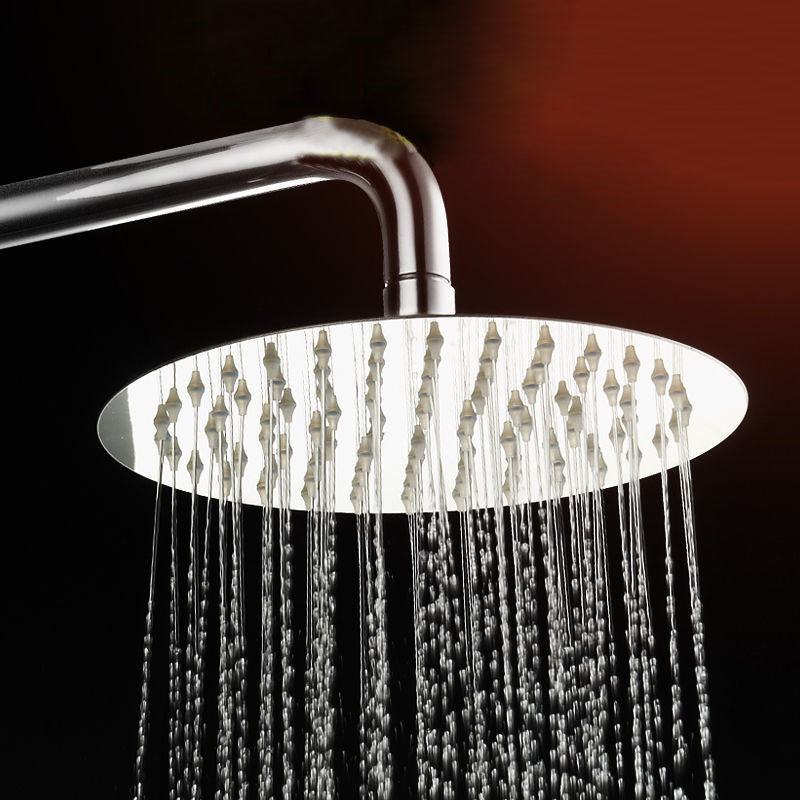
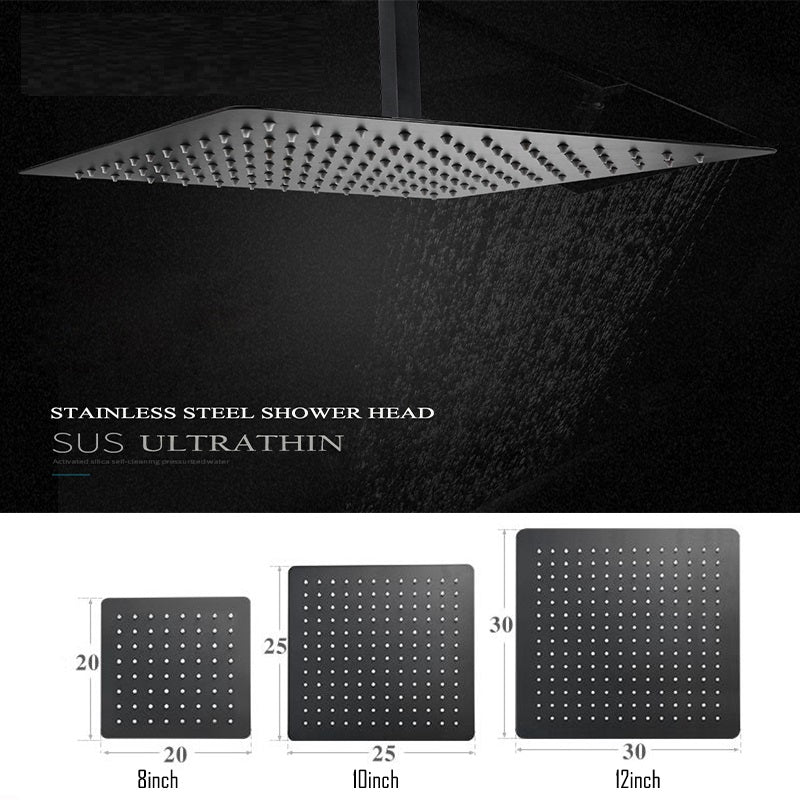
5 Best Matte Black Shower Heads

Disclosure: This site is operated by the same company as Juno Showers, and the products featured below are our own. Specifications shown were accurate at the time of writing and may change. We are not an independent review site.

Matte Black Shower Heads for a Considered Shower System

This list is written for homeowners planning a shower system as one purchase, not a single fixture bought in isolation. These are Fontaine’s own stocked shower heads, presented here in the order that makes the most sense for a matte or brushed black finish: how the mount suits your existing rough-in, and what upkeep the finish itself will ask of you over time. Nothing below has been tested by us. What follows is drawn directly from the specifications supplied by the manufacturer.

How to Choose

  • Mount type first. Ceiling mount heads need a ceiling supply line already roughed in, or a willingness to open the ceiling to add one. Wall mount heads work with a standard wall arm and are the easier retrofit in most bathrooms.
  • Finish care, not just finish color. Black finishes, whether matte or brushed, show hard water spots and soap film more visibly than chrome. A brushed black texture tends to disguise fingerprints and light spotting better than a smooth matte black surface.
  • Hand shower or not. A few of these come paired with a hand shower on the same mount. If your system already specifies a handheld elsewhere, a fixed head without one may suit you better and cost less.
  • Price range signals size options. Several of these are listed as a price range rather than a flat figure, which typically means the head is offered in more than one diameter. Confirm the exact size before you order if ceiling clearance is tight.
  • Match the whole system. A shower head, valve, handheld, and body jets in the same finish family will read as one considered system rather than parts collected over time.

Juno Commercials Ceiling Mount Stainless Steel Shower Head in Turbocharged Black Series

Juno Commercials Ceiling Mount Stainless Steel Shower Head in Turbocharged Black Series

Juno Commercials Ceiling Mount Stainless Steel Shower Head in Turbocharged Black Series suits a bathroom where the ceiling supply is already roughed in, or where a renovation already has the ceiling open. It is priced from $266.25 to $285.25, which indicates more than one size is available under this name, so confirm the diameter against your ceiling clearance before ordering. The finish is black and the mount is ceiling, making it a fit for a system where the valve and handheld are being specified in the same black finish for consistency.

The honest limitation here is the mount itself: ceiling mount heads are not a simple swap onto an existing wall arm. If your bathroom currently has a wall-mounted shower arm and no overhead supply, this head means additional plumbing work before installation, not just a fixture change.

Juno Commercials Ceiling Mount Round & Square Chrome High Pressure Stainless Steel Shower Head
Juno Commercials Ceiling Mount Round & Square Chrome High Pressure Stainless Steel Shower Head

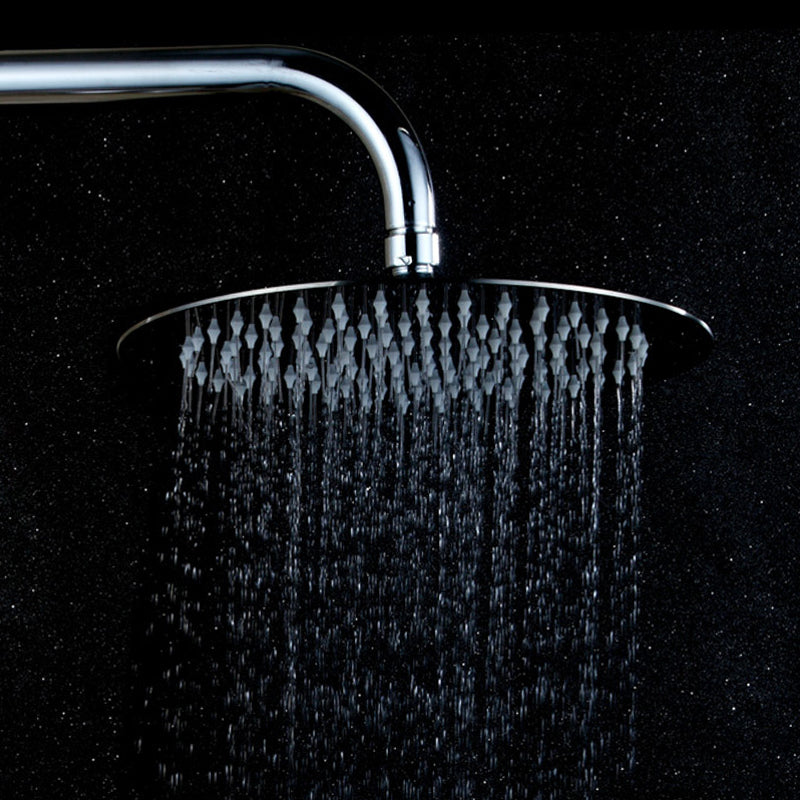
Juno Commercials Ceiling Mount Round & Square Chrome High Pressure Stainless Steel Shower Head is listed here for its black finish, despite the chrome reference in its name, and suits a household that wants either a round or square head silhouette from the same product line without switching manufacturers. Priced from $288.75 to $310.75, it shares the ceiling mount requirement of the piece above.

The limitation worth naming plainly: the product name references chrome, but the finish data for this listing is black. If you are matching finishes across a full system, confirm directly with the specific SKU you intend to order rather than relying on the name alone, since naming and finish do not always align cleanly in this line.

Juno Commercials Ceiling Mounted 10 inch High Pressure Chrome & Black Shower Head with Hand Shower

Juno Commercials Ceiling Mounted 10 inch High Pressure Chrome & Black Shower Head with Hand Shower

Juno Commercials Ceiling Mounted 10 inch High Pressure Chrome & Black Shower Head with Hand Shower suits a homeowner who wants the fixed overhead head and the handheld sourced together as a single unit rather than specified separately. At $282.50 flat, it is priced as a single configuration rather than a range, which simplifies budgeting for a full system. The mount is ceiling and the finish is recorded as black.

The limitation to weigh is the same one that applies to any combined head-and-handheld unit: if the handheld ever needs replacing or servicing independently, you are dealing with a paired assembly rather than two fully separate parts. For a system where the handheld is expected to see more day-to-day use than the overhead head, that is worth considering before ordering.

Juno Commercials Wall Mount Square & Round Ultra-thin Large Shower Head with Hand Shower
Juno Commercials Wall Mount Square & Round Ultra-thin Large Shower Head with Hand Shower

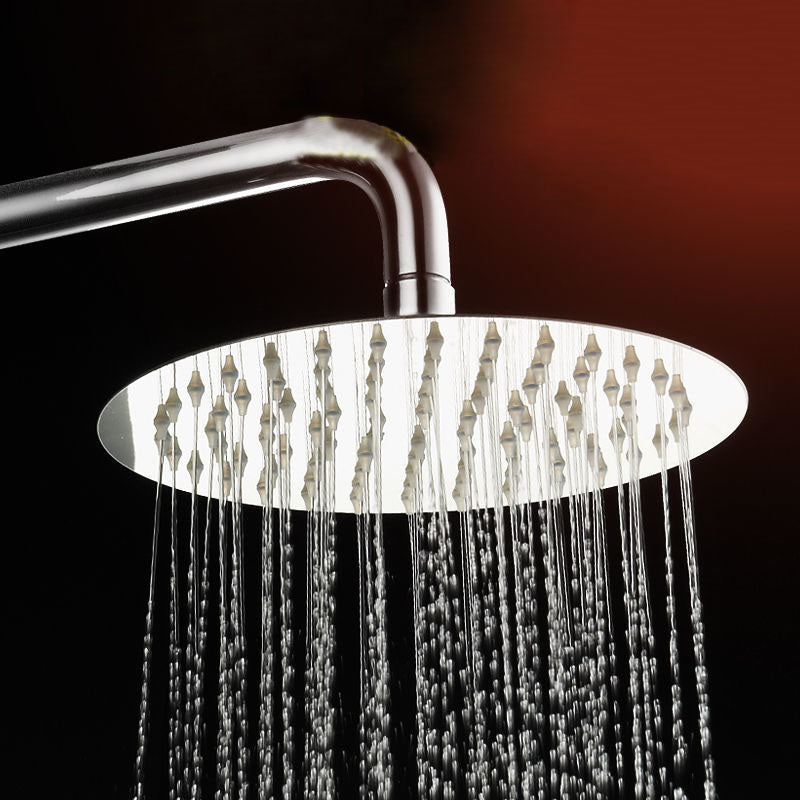
Juno Commercials Wall Mount Square & Round Ultra-thin Large Shower Head with Hand Shower is the wall mount option on this list, and suits the more common retrofit situation where a shower already has a wall-mounted arm and the goal is to upgrade the head rather than reroute plumbing. Priced from $275.00 to $297.00, it is described as large, and also comes with a hand shower included in the same purchase. The finish is black.

The stated limitation is size: a large ultra-thin head needs genuine clearance both from the ceiling above and from any surrounding fixtures or glass. Measure your stall or alcove before ordering, particularly if the shower has a sloped ceiling or a tight enclosure.

Juno Commercials Ceiling Mount Square Brushed Black Ultrathin Rainfall Shower Head
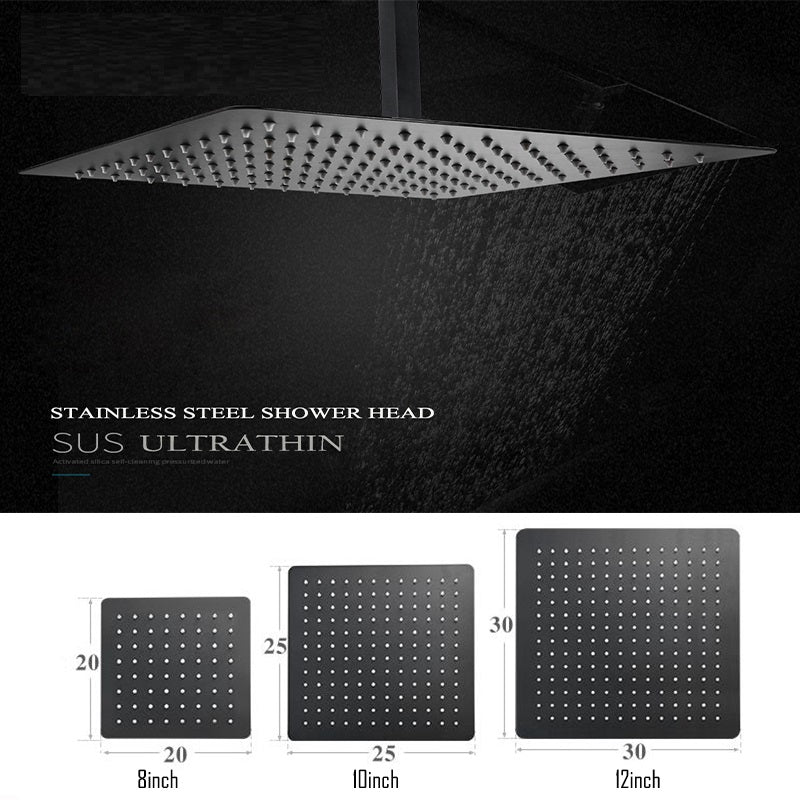
Juno Commercials Ceiling Mount Square Brushed Black Ultrathin Rainfall Shower Head

Juno Commercials Ceiling Mount Square Brushed Black Ultrathin Rainfall Shower Head suits a homeowner who has specifically chosen a brushed texture over a smooth matte black, since a brushed surface tends to disguise water spotting and fingerprints more effectively day to day. It is priced from $298.75 to $327.75, the highest range on this list, and mounts to the ceiling with a square ultrathin profile.

The limitation is straightforward: it is the most expensive option here, and like the other ceiling mount heads on this list, it requires an overhead supply line already in place or added as part of the installation. If your project does not already include ceiling plumbing work, that cost belongs in the budget alongside the fixture price.

Price and Specification Comparison

Name Price Finish Mount
Juno Commercials Ceiling Mount Stainless Steel Shower Head in Turbocharged Black Series $266.25 to $285.25 Black Ceiling
Juno Commercials Ceiling Mount Round & Square Chrome High Pressure Stainless Steel Shower Head $288.75 to $310.75 Black Ceiling
Juno Commercials Ceiling Mounted 10 inch High Pressure Chrome & Black Shower Head with Hand Shower $282.50 Black Ceiling
Juno Commercials Wall Mount Square & Round Ultra-thin Large Shower Head with Hand Shower $275.00 to $297.00 Black Wall
Juno Commercials Ceiling Mount Square Brushed Black Ultrathin Rainfall Shower Head $298.75 to $327.75 Black Ceiling

Before You Order

Measure the space above and around your shower before committing to a ceiling mount head, and confirm whether your existing plumbing already runs to the ceiling or whether that work needs to be added to the project. If you are buying a wall mount head instead, check the reach and angle of your current shower arm against the head’s stated size, particularly for the large ultra-thin option on this list.

If you are specifying a full system rather than a single head, decide early whether the valve, handheld, and any body jets need to match this exact black finish or simply coordinate with it. Two black-finished products from the same line can still differ in texture, as the naming inconsistency on one listing above makes clear, so confirm the finish on the specific SKU rather than assuming it from the product title. Finally, price ranges on several of these listings point to multiple size options under one name, so verify the exact dimension and price before finalizing your order.

5 Best Matte Black Shower Heads

Disclosure: This site is operated by the same company as Juno Showers, and the products featured below are our own. Specifications shown were accurate at the time of writing and may change. We are not an independent review site.

This list is for homeowners assembling a complete shower system through Fontaine Showers, where the head is chosen alongside a valve, handheld, and in some cases body jets rather than picked in isolation. These are our own products, drawn from the Juno Commercials line, and we are not claiming any of them have been tested or ranked by outside reviewers. The order below runs from ceiling-mounted single heads through to combination units with an integrated hand shower, since that is the decision most readers are actually making: fixed overhead spray, or overhead paired with a handheld for rinsing and cleaning.

How to choose

  • Mount type first. Ceiling mount needs overhead rough-in already run or planned; wall mount works with a standard wall-fed supply and suits bathrooms where the ceiling isn’t accessible or isn’t finished for plumbing.
  • Matte and brushed black finishes need different care than chrome. They resist fingerprints better but still show mineral spotting from hard water, so a non-abrasive cloth and a residue-free cleaner matter more than they would on a polished finish.
  • Decide if you want a hand shower built into the system. Two of the picks below include one paired with the fixed head; the others are fixed-head only and would need a separate handheld and diverter to complete a full system.
  • Check the price range, not just the headline number. Several of these are listed as a range rather than a flat price, which usually reflects head size or shape options, so confirm the exact configuration before ordering.
  • Confirm head size against your ceiling or wall layout. A 10 inch or “large” head needs more overhead or wall clearance than a compact round head, particularly in a shower stall with a lower ceiling.

Juno Commercials Ceiling Mount Stainless Steel Shower Head in Turbocharged Black Series

Juno Commercials Ceiling Mount Stainless Steel Shower Head in Turbocharged Black Series

Juno Commercials Ceiling Mount Stainless Steel Shower Head in Turbocharged Black Series is a ceiling-mounted stainless steel head in black, priced from $266.25 to $285.25. It suits a homeowner who already has, or is planning, overhead supply plumbing and wants a stainless build in a matte black finish as the centerpiece of a ceiling-fed system. The stated price range suggests more than one size or configuration is available under this name, so it is worth confirming which one matches your rough-in before ordering. The honest limitation here is the mount itself: ceiling mount is not a drop-in swap for a wall-fed shower, and retrofitting overhead supply into an existing bathroom is a larger job than replacing a wall arm.

Juno Commercials Ceiling Mount Round & Square Chrome High Pressure Stainless Steel Shower Head

Juno Commercials Ceiling Mount Round & Square Chrome High Pressure Stainless Steel Shower Head

Juno Commercials Ceiling Mount Round & Square Chrome High Pressure Stainless Steel Shower Head is listed in the black finish here, ceiling mounted, with pricing from $288.75 to $310.75. The round-and-square naming points to a choice of head geometry, which suits a household deciding between a softer round profile and a more architectural square one for the same ceiling-fed system, without having to change product lines. Because the listing spans a price range tied to that shape or size choice, the specific configuration should be confirmed against the quote before the order is placed. The limitation to weigh is that a wider price band usually means less certainty at a glance about what you’ll pay until the exact spec is locked in.

Juno Commercials Ceiling Mounted 10 inch High Pressure Chrome & Black Shower Head with Hand Shower

Juno Commercials Ceiling Mounted 10 inch High Pressure Chrome & Black Shower Head with Hand Shower

Juno Commercials Ceiling Mounted 10 inch High Pressure Chrome & Black Shower Head with Hand Shower comes in black, ceiling mounted, at a flat $282.50, and pairs a 10 inch fixed head with a hand shower in one listing. This suits a reader who wants the fixed-plus-handheld combination settled in a single purchase rather than sourcing the handheld separately, which simplifies matching finishes across the system. The flat price is a plus for budgeting compared to the ranged listings above. The limitation is the fixed 10 inch size: that dimension needs to be measured against the ceiling height and shower footprint before ordering, since a head that size will not suit every stall.

Juno Commercials Wall Mount Square & Round Ultra-thin Large Shower Head with Hand Shower

Juno Commercials Wall Mount Square & Round Ultra-thin Large Shower Head with Hand Shower

Juno Commercials Wall Mount Square & Round Ultra-thin Large Shower Head with Hand Shower is a black, wall-mounted head priced from $275.00 to $297.00, offered in both square and round profiles and bundled with a hand shower. It suits bathrooms without ceiling rough-in, or a renovation where wall-fed supply is already in place and the homeowner doesn’t want to open the ceiling. The ultra-thin, large design is meant to sit close to the wall while still covering a wide spray area. The limitation is that “large” and “ultra-thin” together mean the head extends outward on its arm more than a compact head would, so wall clearance and the swing of a shower door should be checked before it goes on the wall.

Juno Commercials Ceiling Mount Square Brushed Black Ultrathin Rainfall Shower Head

Juno Commercials Ceiling Mount Square Brushed Black Ultrathin Rainfall Shower Head

Juno Commercials Ceiling Mount Square Brushed Black Ultrathin Rainfall Shower Head is a ceiling-mounted, square, brushed black rainfall head priced from $298.75 to $327.75, the highest range in this list. It suits a homeowner set on a minimalist square rainfall profile overhead, where the brushed texture is chosen specifically to soften fingerprints and light scuffing compared with a polished black finish. The limitation is finish care: brushed black still shows hard water spotting over time and needs a non-abrasive, residue-free cleaner, and because it is a texture rather than a coating, aggressive scrubbing can dull the brushed pattern faster than it would a smooth finish.

Product Price Finish Mount
Juno Commercials Ceiling Mount Stainless Steel Shower Head in Turbocharged Black Series $266.25 to $285.25 Black Ceiling
Juno Commercials Ceiling Mount Round & Square Chrome High Pressure Stainless Steel Shower Head $288.75 to $310.75 Black Ceiling
Juno Commercials Ceiling Mounted 10 inch High Pressure Chrome & Black Shower Head with Hand Shower $282.50 Black Ceiling
Juno Commercials Wall Mount Square & Round Ultra-thin Large Shower Head with Hand Shower $275.00 to $297.00 Black Wall
Juno Commercials Ceiling Mount Square Brushed Black Ultrathin Rainfall Shower Head $298.75 to $327.75 Black Ceiling

Before ordering any of these, measure the shower stall and ceiling or wall clearance against the specific head size listed, since round, square, ultra-thin, and 10 inch designations all change how much room the fixture needs. Confirm what supply plumbing already exists: ceiling mount requires overhead rough-in, while wall mount works from a standard wall-fed line, and switching from one to the other mid-renovation is a plumbing change, not just a fixture swap. If this head is being added to a bathroom that already has black fixtures, such as a valve trim or towel bar, compare the finish names directly, since matte and brushed black can read differently side by side even when both are described simply as black. Finally, where a listing shows a price range rather than a flat number, get the exact configuration and size confirmed in writing before the order is placed, so the system arrives matched to the rough-in that’s already in the wall or ceiling.

Body Jets: When the Wall Work Is Worth It

Body jets are worth the plumbing cost only if the valve, manifold, and supply line behind the wall can deliver enough water to run them alongside the head and handheld without starving any of the three. That’s a rough-in and flow-rate question before it’s a comfort question. If your system can’t hit the combined GPM, you end up with weak jets, a stuttering head, or a compromise where you’re only ever running one outlet at a time, which defeats the point of buying jets in the first place.

What Body Jets Demand From the Valve

Every additional outlet on a shower system adds load to the valve, and the valve’s job is to hold temperature and pressure steady no matter how many outlets are open. This is where the difference between thermostatic and pressure-balancing valves actually matters, not as a spec sheet line but as lived behavior in the shower.

A pressure-balancing valve keeps the hot-to-cold ratio constant by reacting to pressure changes on either the hot or cold side. It works fine for a single outlet or two outlets with modest combined draw, but when you open a third or fourth outlet, the valve has to fight harder to keep that ratio balanced. You’ll feel it as a temperature dip or a slow drift when jets kick on.

A thermostatic valve reads actual water temperature, not just pressure ratio, and adjusts the hot/cold mix accordingly. Under multi-outlet load, this makes it more stable. For any system with body jets running simultaneously with a head and handheld, thermostatic is the safer spec. Pressure-balancing can work in a two-outlet system, but once you’re routing water to four or more places at once, thermostatic control gives you a wider margin before someone standing in a body jet spray notices a temperature swing when another outlet opens.

GPM Math: Jets Plus Head Plus Handheld

The math is simple once you have the numbers, and the numbers are what most homeowners skip. A standard shower head is capped at 2.5 GPM federally, 1.8 GPM in California and a handful of other states with their own standards. A handheld typically runs close to the same range, often 1.8 to 2.5 GPM depending on the model. Body jets are not federally capped the way heads are, and they typically run 2 to 4 GPM per jet depending on nozzle size and design.

Add it up. A system with one head, one handheld, and four body jets could look like this if everything is running at once:

  • Shower head: 2.5 GPM
  • Handheld: 2.0 GPM
  • Four body jets at 3 GPM each: 12 GPM
  • Total demand: 16.5 GPM

That number matters because a typical 3/4 inch supply line has a practical delivery capacity in the range of 10 to 12 GPM at normal residential pressure, depending on pressure at the meter, pipe length, and how many fittings and elbows are between the main and the shower. A 1/2 inch NPT connection at the fixture end narrows things further. If your rough-in is feeding this system off a 3/4 inch line, you are already short before you account for other fixtures pulling from the same branch.

This is why most functional body jet systems are designed around partial simultaneous use, not full simultaneous use. A well-specified system lets you run the head and two jets together, or the handheld and all four jets, but reserves full six-outlet operation for a diverter setting you rarely use. If a system spec sheet promises unrestricted full-flow operation across every outlet at once, ask what supply line size and static pressure that claim assumes, because it is not achievable on a standard residential 3/4 inch line without a booster pump or a larger main.

Manifold and Diverter Options for Multi-Outlet Systems

The diverter is what decides which outlets get water and how much, and the type of diverter you spec changes what’s actually possible in the wall.

Diverter Type How It Works Best Fit
3-way Routes flow to one of three outlets, or split between two, using a single handle Simple systems: head, handheld, one body jet zone
6-way Controls up to six outlets from a single valve trim, often with sequential or combination settings Systems with multiple jet zones plus head and handheld, moderate supply capacity
Manifold-style Uses a dedicated distribution manifold behind the wall, often with individual volume controls per outlet Full body jet systems where independent flow control per jet or per zone is required

A 3-way diverter is fine for a head-plus-handheld system with no jets, or one jet zone. Once you’re running four or more jets in addition to a head and handheld, a manifold-style setup gives you the most control, because it lets you dial back flow to specific jets rather than relying on the diverter to just turn zones on and off. That control is what makes a marginal supply line workable, since you can run jets at reduced volume instead of full GPM and stay within what the line can deliver.

Wall Cavity and Rough-In Realities

Body jets are not a trim-level decision. Every jet needs its own supply line run through the wall cavity back to the manifold or diverter, and that run has to be planned before drywall goes up. A 2×4 wall gives you roughly 3.5 inches of depth to work with once you account for the stud and any blocking, which is workable for individual jet supply lines but tight if you’re also running a large-format valve body or manifold assembly in the same cavity. Many multi-outlet systems end up specified for a 2×6 wall specifically to give the manifold and its fittings room to sit without being crushed against the finish surface.

Rough-in also means committing to jet placement before tile goes on, since jets are typically set at torso height in a pattern that doesn’t move once it’s plumbed. If you’re gutting a shower anyway, this is the point where reviewing complete shower systems as a matched valve, head, handheld, and jet package makes sense, since it lets your plumber size the manifold and supply runs to the system’s actual combined GPM instead of guessing at compatibility after the fact.

Water heater capacity is the other piece people forget. A tankless unit or tank sized for a single shower head runs into trouble fast when it has to supply 15+ GPM of hot water on demand. Check your water heater’s flow rate at your target temperature rise before committing to a jet count, not after.

When a Simpler System Makes More Sense

If your existing supply line is 1/2 inch or your main service is undersized for the house, adding four body jets to a system means either living with weak flow everywhere or paying to upsize the line, which usually means opening more wall than a straightforward shower renovation calls for. In that situation, a head and handheld on a thermostatic valve, or a head and handheld plus one or two jets rather than a full bank, gets you most of the experience without demanding plumbing work the house wasn’t built to support.

Before you sign off on a body jet system, get the actual numbers: your static water pressure, your supply line size from meter to shower, and your water heater’s flow rate at temperature. A plumber can measure static pressure in about five minutes with a gauge on an outside spigot. If those numbers support 15+ GPM at your target temperature, spec the jets and the thermostatic valve to match. If they don’t, scale the jet count to what the line can actually deliver, or plan the line upsize as part of the same job instead of finding out after the tile is set.

No Shutoff Valve? Isolating a Full Shower System Safely

If your shower system has no local shutoff, your only option is the main water shutoff for the house or the branch line feeding the bathroom, and that’s the problem. A complete shower system with a thermostatic or pressure-balance valve, two to six body jets, and a handheld diverter has multiple supply and distribution points. Cutting water at the main to fix a dripping body jet means the whole house goes dry, and it means guessing whether you’ve actually isolated the right line when you turn it back on. The fix is isolation valves installed at the time of rough-in, not located after something fails.

Why Multi-Outlet Systems Need Isolation Valves

A single showerhead installation has one hot line, one cold line, and one valve body. A full system changes that math. A thermostatic mixing valve typically has hot and cold inlets plus one or more outlets feeding a diverter, which then splits to the fixed head, handheld, and body jet manifold. Each of those branches is a place where a cartridge can fail, a fitting can weep, or a body jet can need replacement. Without dedicated stops, servicing any single component means shutting down water to the entire bathroom, and often the adjacent rooms sharing that branch line.

This is not a hypothetical maintenance concern. Body jet manifolds in particular see more wear than a showerhead because they’re running multiple nozzles off shared supply, often at higher combined flow, and the small-diameter tubing to each jet is more prone to mineral buildup and fitting fatigue over time. When one jet needs service, you want to isolate that manifold only, not the thermostatic valve feeding the whole system.

Locating the Main Shutoff Safely

Before doing anything else, confirm where your main shutoff actually is and that it operates freely. In most homes this is where the supply line enters the foundation, in a basement, crawlspace, or utility closet, or at the meter itself if there’s a curb stop. Turn it a quarter turn or a few full turns (depending on valve type) once a year so it doesn’t seize. A main valve that hasn’t been touched in a decade is a real risk during an actual emergency, when you need it to close immediately and completely.

If your only option in a shower emergency is the main, you’re also shutting off every other fixture in the house. That’s acceptable for a genuine emergency (a supply line has split, water is spraying) but it’s not a workable solution for routine maintenance, which is exactly why isolation valves at the fixture matter.

What Code Requires for Accessible Shutoffs

Both the International Plumbing Code and the Uniform Plumbing Code require accessible shutoff valves for individual fixtures, typically specified as being installed on the supply line ahead of the fixture and located so they can be reached for operation and repair without removing permanent construction. The exact section numbers vary by code edition and local amendments, so check with your jurisdiction’s adopted code and any local amendments before final rough-in, but the principle is consistent across both models: every fixture supply should have its own accessible stop.

For a shower system, “the fixture” isn’t just the showerhead. Code officials generally expect stops on the hot and cold supply to the valve body itself, accessible through an access panel if the valve is behind a wall. Whether body jets need their own separate stops beyond the main valve isolation is often a matter of local interpretation and inspector discretion, which is why it’s worth building in more isolation than the bare code minimum, especially given how much harder body jet plumbing is to access once tile is set.

Adding Stops When You Install Valve and Jets

This is the point where isolation should be designed in, not retrofitted. If you’re specifying a complete system with a plumber, get isolation valves on the plans before rough-in inspection, not as a change order after tile is up.

  • Main supply stops: 1/2 inch NPT quarter-turn ball valves on the hot and cold lines feeding the thermostatic or pressure-balance valve body, installed in an accessible location, typically behind a removable access panel on the opposite side of the wall from the shower.
  • Body jet manifold isolation: a separate stop (or set of stops, if jets are on individual lines rather than a shared manifold) between the diverter output and the body jet distribution, so a jet or manifold fitting can be serviced without draining the main valve supply.
  • Handheld diverter branch: usually covered by the main valve stops since the diverter is typically integral to or just downstream of the primary valve, but confirm this with your plumber based on the specific valve trim you’re installing.
  • Access panel placement: plan the panel location during framing, sized to reach the valve bonnet and any stops, and finished in a way that doesn’t require destructive removal (a magnetic or hinged access panel matched to the wall finish, not a tiled-over cutout).

Quarter-turn ball valves are worth specifying over multi-turn gate or globe stops. A ball valve gives a visual and tactile confirmation of open versus closed with a 90-degree turn, seats more reliably after years of infrequent use, and is less prone to the packing leaks that older multi-turn stops develop. The cost difference between a quarter-turn ball valve and a multi-turn stop is minor relative to the rest of a system installation, and the reliability difference shows up exactly when you need it, which is usually years after installation when nobody remembers which way to turn a gate valve.

Isolation Point Typical Location Valve Type Recommended
Main house shutoff Foundation entry, basement, or meter Quarter-turn ball valve where code and local water authority allow
Valve body supply (hot/cold) Behind access panel opposite shower valve 1/2 inch NPT quarter-turn ball valve
Body jet manifold Behind access panel near manifold location Quarter-turn ball valve, one per manifold or per jet zone
Handheld diverter branch Usually integral to main valve trim Confirm with valve manufacturer’s spec sheet

Emergency Shutoff With No Local Valve

If you’re dealing with an active leak right now and there’s no isolation valve installed, go straight to the main shutoff for the house. Turn it fully closed, then open the shower’s fixtures (head, handheld, and body jets if accessible) to relieve pressure in the lines and confirm the water has actually stopped. Don’t assume the main is closed just because you turned the handle; check for pressure at an open fixture.

Once the immediate leak is controlled, that’s the point to call a plumber, not to attempt a repair on a system with no service stops. Trying to open the wall and replace a cartridge or fitting while running on the main shutoff means the rest of the house has no water, which is impractical for anything beyond a same-day fix. This is also the moment to have isolation valves added as part of the repair, so the same situation doesn’t force a whole-house shutdown next time.

Labeling and Testing Valves After Install

Once stops are in, they only help if you and anyone else working on the house can find and identify them. Label each valve at the access panel: which line it controls (hot supply, cold supply, body jet manifold), and confirm open and closed positions are obvious from the handle orientation on a quarter-turn ball valve.

Test every new stop before the access panel is closed up for good. Close each valve individually and confirm the corresponding fixture loses flow while the others keep working. This catches installation errors, like a stop plumbed to the wrong branch, while it’s still easy to fix. Do this test again a year after installation to confirm the valves haven’t seized, and once a year after that as routine maintenance.

If you’re specifying a new shower system now, put isolation valves on the plumber’s scope of work in writing before rough-in, not as an afterthought. Ask specifically for 1/2 inch NPT quarter-turn ball valves on the main valve supply and a separate stop for the body jet manifold, with an accessible panel sized for future service. If you already have a system with no local shutoff and you’re not mid-emergency, this is worth doing as a planned retrofit rather than waiting for a failure that forces a rushed, main-shutoff-only response.

FontanaShowers


Top FontanaShowers® Products for Commercial Projects (Architect’s Guide)


Architect’s Guide: Top FontanaShowers® Products for Commercial & Hospitality

Curated, spec-ready selections—luxury shower systems and touchless sensor faucets—with quick-scan specs, compliance notes, and clear rationale on why these outperform typical market alternatives.

B2B · Spec-Driven

Below are proven FontanaShowers® picks we recommend for offices, hotels, airports, stadiums, and multi-family. Links go to the official product/category pages for submittals, BIM files, and installation docs where available.

Top Picks (With Architect Notes)

Fontana Barco 5G WiFi LED Multifunctional Shower System

Digital/LED
Thermostatic
Rain + Body Jets
WiFi features

High-end, integrated set for premium hospitality suites. Digital control + LED feedback improves guest UX and maintenance diagnostics versus basic mixers.

  • Integrated feature stack (rainfall, jets, handheld) reduces multi-vendor coordination.
  • Thermostatic stability helps mitigate scald risk and nuisance callbacks.
  • LED status cues simplify housekeeping checks.

View in Fontana Luxury Shower Systems

Fontana Azzurra 20" Thermostatic Shower System

Thermostatic Valve
Large Rainhead
Premium Finishes

Large-format rain experience in a restrained form factor—ideal for upscale multi-family or boutique hotels seeking a spa feel without complex integration.

  • Thermostatic control maintains setpoint under variable demand.
  • Finish breadth supports coordinated design palettes.

See product in category

Fontana Royal Matte Black Digital Rainfall LED Shower System

Digital + LED
Contemporary Aesthetic
Commercial-grade build

Modern, guest-friendly controls meet durable construction—well-suited to lifestyle hotels and high-end rentals.

  • Digital interface reduces user confusion vs. multi-handle setups.
  • Matte black finish aligns with current hospitality design trends.

See product in category

Sainte-Anne Gun Grey Touchless Deck Faucet

Infrared Sensor
Solid Brass
Commercial

Reliable activation and on-trend finish for premium commercial restrooms; reduces water waste and touch points vs. manual faucets.

  • Hands-free hygiene + auto shut-off for conservation.
  • Design-forward finish options for signature restrooms.

View Fontana Touchless Faucets

Laquila Brushed Nickel Automatic Sensor Faucet

Infrared Sensor
Commercial
Multiple Finishes

Workhorse touchless faucet for high-traffic washrooms—balanced aesthetics and performance at scale.

  • Consistent detection minimizes false triggers and “hand waving.”
  • Brushed nickel conceals wear—ideal for airports/education.

Browse models & specs

Dijon Touchless Faucet + Automatic Soap Dispenser (FS18128)

Faucet + Dispenser Kit
Commercial
5-Year Warranty

All-in-one kit simplifies submittals and installation coordination; ideal for rollouts where spec consistency matters.

  • Single-vendor kit helps avoid sensor interference and mismatch.
  • Warranty & documentation package streamlines approvals.

See product page & docs

Brio Wall-Mount Commercial Sensor Faucet (Matte Black)

Wall-Mount
Hands-Free
Water-Saving

Wall-mount keeps decks clear and eases cleaning—great for premium public restrooms and foodservice back-of-house.

  • Touch-free operation reduces germ spread and utility costs.
  • Robust build for high-use, high-abuse environments.

View spec page

Fontana Antique Commercial Touchless Faucet

Classic Aesthetic
Solid Brass
Sensor-Activated

For heritage or boutique projects that need period-appropriate styling without sacrificing touchless hygiene.

  • Infrared activation with durable brass construction.
  • Pairs with bronze/antique finishes throughout a project.

View spec page

Why These Beat Typical Competitors

Integrated Tech & Controls

Fontana’s luxury shower systems combine thermostatic control with digital/LED feedback—reducing user confusion and maintenance versus piecemeal component builds.

Explore the luxury shower system range

Touchless Reliability at Scale

The touchless lineup emphasizes consistent detection, water savings via auto-shutoff, and finish variety—important for brand-standard restrooms from corporate offices to hospitality.

Browse touchless sensor faucets

Docs & Warranty for Submittals

Representative kits (e.g., faucet + dispenser set) include installation instructions, BIM/spec sheets, and a 5-year manufacturer warranty—streamlining approvals and O&M turnover.

See kit details & downloads

Spec & Compliance Notes

Line What to Specify Architect Tip
Luxury Shower Systems Thermostatic valve setpoint, outlet configuration (rain/hand/jet), supply pressure range, finish. For mixed-use or hotels, thermostatic stability reduces service calls; choose finishes aligning with suite design packages.
Touchless Deck/Wall Faucets Power (battery vs. transformer), sensor range, flow rate (GPM/LPM), mounting type, finish. Use transformer power for heavy traffic; wall-mount improves cleanability and vandal resistance in public venues.
Faucet + Dispenser Kits Coordinate cut-outs, spacing, and power for both devices; confirm soap viscosity range. Kits simplify procurement and reduce integration issues vs. mixing brands.

Get Samples, Submittals, or Pricing

Ready to spec? Start with the primary collections:

Luxury Shower Systems ·
Touchless Sensor Faucets ·
Faucet + Soap Dispenser Kit

© 2025 Fontaine Sensor Faucets • This guide highlights FontanaShowers® products for professional specification. Always verify local code requirements and final cut-sheets prior to submittal.